I Don’t Know….

Caleb

I don’t know all the answers.

I know that doesn’t surprise those of you that know me. I am a life long learner and I love to ask questions.

(much to the annoyance of my husband, our son, and I am sure, my three sons-in-law)

They don’t like it when I ask questions during ball games. How else am I going to learn the intricacies of the game? I just want to know why the football coach threw down his clipboard or why the baseball umpire ejected the coach. Ok, so I am more interested in the personal interactions of the coaches, players, and officials than the game itself, but I am watching.

We all learn by asking questions. Children go though stages when they ask many more questions than at other times. We get weary of answering, but that is how we as humans learn.

We are much more likely to remember information that we inquired about than if we are just fed facts. Our brains are “wired” to process immense amounts of information, yet MEMORY is tied to connecting information according to usefulness. Our brains are amazing at sorting.

That is why it is SO IMPORTANT to answer our children’s questions. If they ask a question – they want an answer. If we don’t answer their questions, they will begin to find others who will. Those may not be the people who will give our children good or correct answers. Peers are a ready source of information – some positive, some questionable, and some down right negative.

Be the adult who answers questions.

But what about when we don’t know?

Some possible responses are:

  • Be honest. I am highly suspect of anyone who knows it all – even if they do listen to NPR.
  • “I don’t know, but I will help you find out.” This allows our children to see where we look for answers ourselves.
  • “Let’s call and ask…..” Let your child see that there are others you recognize as an expert in a certain area.
  • “I don’t know for sure, and people I respect think differently about this.” (questions about heaven, Jesus’ return, etc.)
  • Google it. (be careful – do this together with your child)

God knows that we don’t know it all. If fact, James gives us advice about what to do in James 1:5-6

5 If you need wisdom, ask our generous God, and he will give it to you. He will not rebuke you for asking. 6 But when you ask him, be sure that your faith is in God alone. Do not waver, for a person with divided loyalty is as unsettled as a wave of the sea that is blown and tossed by the wind.

We are encouraged to ask God, and ask with faith that He will answer. Yet, sometimes we know that God waits to respond or chooses to keep silent in certain areas for our good. We do this as parents or grandparents, don’t we. We don’t tell our small children that we are taking them to Tweetsie next week because they will find it difficult to wait, or to do what they need to do today.

God also tells us that we don’t know everything, nor will we until we meet God face to face.

1 Corinthians 13:11 (NLT)

11 When I was a child, I spoke and thought and reasoned as a child. But when I grew up, I put away childish things. 12 Now we see things imperfectly, like puzzling reflections in a mirror, but then we will see everything with perfect clarity. All that I know now is partial and incomplete, but then I will know everything completely, just as God now knows me completely.

What a wonderful promise!!! God is so awesome and His plans for us are beyond our human comprehension.

One day we will know it all – with perfect clarity. We can share that with our children and grandchildren.

I will never forget  – because it was one of those moments seared in my memory – Elizabeth Elliot speaking to 10,000 college students at Urbana in 1973 sharing the following –

I don’t know … but I know the One who does.”


Got Milk?

image

Our new granddaughter is now 3 months old. She is starting to respond to her surroundings, especially her family.

Those first smiles make it all worth it, don’t they?

SO PRECIOUS!

She doesn’t cry much, which is a HUGE blessing since her 4 older brothers need a lot on supervision right now. They are at the “let me see what happens if I do this….” stage.

You will remember this stage if your children are older now because you found yourself saying things like:

  • What were you thinking?  … they weren’t thinking
  • Why did you do that?         ….there often is no reason
  • I can’t believe you did that! ….they can’t either
  • What is the matter with you?…they are children

Does God ever throw up His divine hands in exasperation? Knowing that His eye is on me… I’m sure He does.

But He never gives up!  Praise God!

Neither should we.

Back to our new granddaughter – she does let it be known when she is hungry. She is also quickly satisfied when she receives her mother’s milk. Babies are designed to crave the very things they need for healthy growth and development.

Peter has some words of instruction for us as we grow as Christians –

1 Peter 2: 1-3 (NLT)

2 So get rid of all evil behavior. Be done with all deceit, hypocrisy, jealousy, and all unkind speech. 2 Like newborn babies, you must crave pure spiritual milk so that you will grow into a full experience of salvation. Cry out for this nourishment, 3 now that you have had a taste of the Lord’s kindness.

We are encouraged to “cry out” for the nourishment we need from the Lord.

Notice that it says – “we must crave pure spiritual milk” so that we can grow into a full experience of salvation. It is an ongoing process.

I am also struck by the phrase “now that you have had a taste of the Lord’s kindness.”

It is the kindness of the Lord that leads us to repentance. Kind speech is the best way for us to reflect God’s kindness as we interact with our children, grandchildren, and each other.

Our challenge is to drink in that pure spiritual milk ….and let kindness pour out.

Emphasis

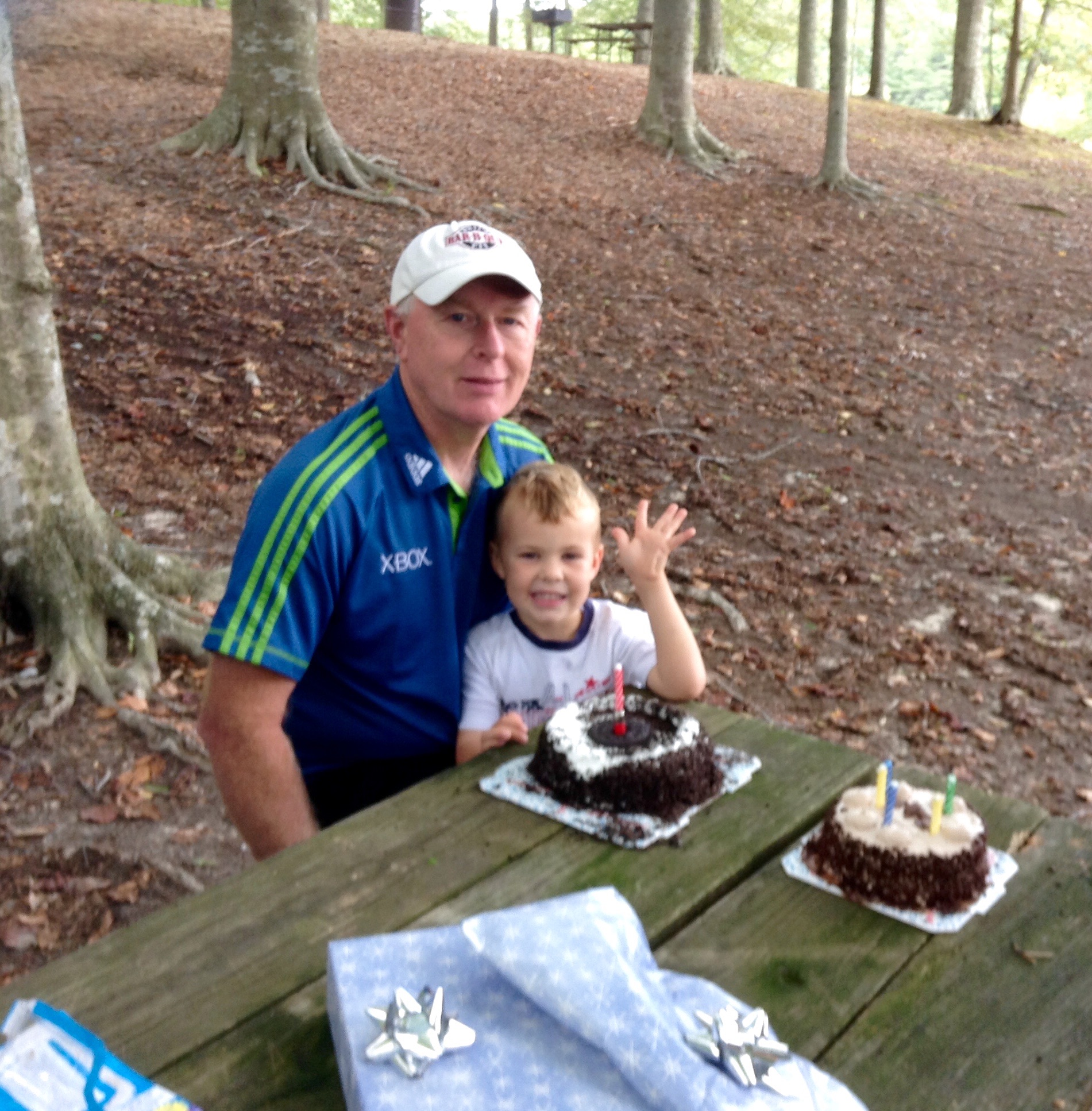
Daniel is 5!

Daniel is 5!

“Happy Birthday to YOU!”

This is something to celebrate!

Children, and all those who are young at heart enjoy birthdays. It is not just about getting older, it is reaching that milestone of another year. It is a day when we emphasize a person and what they mean to us. For our children, it is a day to make them feel significant as a part of our family.

In art, emphasis is described as “special attention or importance given to one part of a work of art”. This often causes the piece of art to communicate meaning because of what is emphasised. An example is the Last Supper by Leonardo DaVinci. One’s eye automatically goes to the middle of the painting  – to Jesus – because of the placement of the figures on each side, the perspective of the walls, and the lightness of Jesus’ robe. All these qualities emphasis the importance of Jesus, the focal point of the painting.

When we celebrate members of our families, we emphasize their importance which results in their feeling loved and appreciated. Each family celebrates in unique ways. It does not require a lot of money to make a child feel special. In fact, spending more may result in less personal attention.

Some thoughts to consider when planning children’s’ birthday celebrations:

  • limit the number of friends to the age of the child (this does not include cousins, who are entitled to come)
  • ask the child what they would like to do for their party (one of our children wanted friends to come and play baseball – how fun and easy was that!) One grandchild had a camp out in the backyard with a movie projected on a sheet hung from the deck.
  • if the child wants to go to Paris, France – discuss the realities of life, and then plan accordingly
  • during warm weather – one grandchild had a water party with water games like water balloons and watergun battles
  • decorations can be simple – don’t fall in the trap of copying a Pinterest layout that stresses you out for a two-year old – the child won’t notice
  • as children get older, the parties do NOT have to get bigger and bigger. A special outing as a family may be a chance to celebrate that child and his/her interests.
  • make sure the celebration is about that child  – not the photo ops.
  • most importantly – let your child know how thankful you are that God added him or her to your family

In Psalm 127, Solomon is rejoicing in God’s blessing of giving children. In verse 3 he says –

3 Children are a gift from the Lord;
they are a reward from him.

Are we responding to our children in such a way that they know they are a blessing to us? Or do they feel like they are in the way….a bother?

We must let our children know daily – not just on their birthdays –  that we are so thankful that God joined them to our family.

May we place emphasis on each child’s value to ourselves and to God.