Abundance to Share

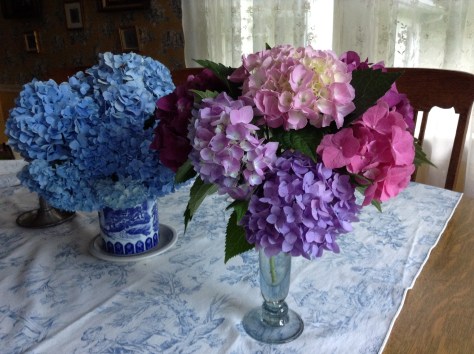
img_5190

We have been blessed with many different varieties of flowers in our yard. I enjoy each one, but truth be told, I do have my favorites.

Hydrangeas.

I love them all, white, blue, purple, pink, and any variations thereof. Phil has accused me of treating the plants I like better than the plants which are not my favorite. I suppose unconsciously I do so. Hydrangeas make me smile.

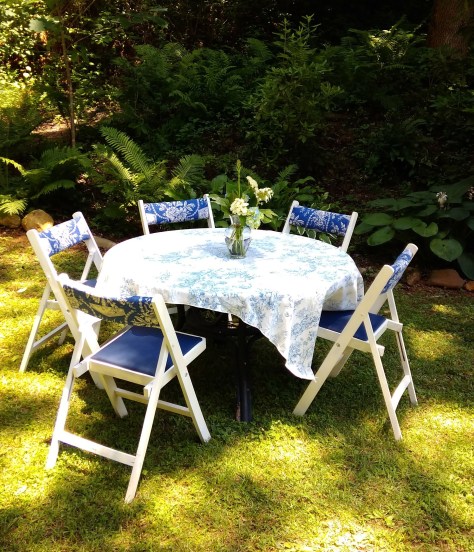
I have even made table cloths from fabric that compliment the blue hydrangeas. This creates a lovely table setting when the hydrangeas are the center piece. They make me want to invite guests for dinner to share in their beauty.

That brings me to the point. All these flowers are so lovely – it is a blessing to share them. Lately I have had several opportunities to do so. I could just cut them and put them in vases all over the house. (I have done that at times)

It is so much more fun to share them with others so they can enjoy them as well.

p_20180609_125135.jpg

Garden Shower

God encourages us to share, even our favorite things.

Ephesians 4:28 (NIV)

28 Anyone who has been stealing must steal no longer, but must work, doing something useful with their own hands, that they may have something to share with those in need.

Notice the purpose of useful work is not to gain personal wealth – but to have enough to SHARE with those in need.

Luke 3:11 New International Version (NIV)

11 John answered, “Anyone who has two shirts should share with the one who has none, and anyone who has food should do the same.”

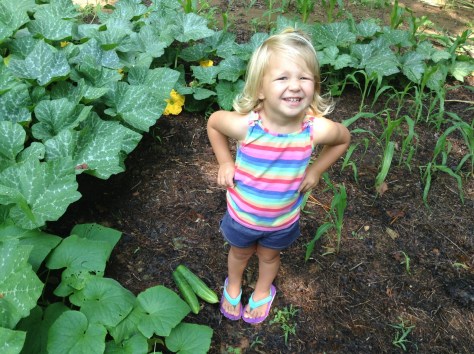
Mountain people have always been sharing the fruit of their gardens. I know folks who plant extra rows of beans and corn just so they have more to share with others. (they don’t need to plant extra rows of squash – they multiply on their own)

I am blessed by the abundance of flowers this year. I am even more blessed when I can share them with others.

What do you have to share?

God will show you if you ask – then be prepared to receive a blessing.


In My Garden with God – #11


“They Need to See Each Other”

When my father passed away several dear friends gave me gift cards to purchase a plant in his honor. This was especially fitting since my father was a botanist and naturalist, as well as a biology teacher.

I knew immediately what I wanted to plant in his honor… an American chestnut tree, blight resistant.

When my father became a seasonal ranger in the Great Smoky Mountains National Park in 1959, one still saw many towering gray tree trunks of dead American chestnuts, the last vestiges of a once mighty species of tree in our mountain forests.

Years later when my parents were living with us, Dad told me that he had read about a blight resistant American chestnut that had been developed and was showing promise of thriving in our mountain habitat. He mentioned that we should get one. I called around to a few local nurseries and no one had any of this variety yet.

So, after my father passed away at 91 years old, I again called the nursery and sure enough, they had American chestnut trees. Phil and I went to pick one up and the man helping us said,

“Now you need two so they can cross pollinate and you then you will get chestnuts.”

Of course – Biology 101.

Thinking about the many trees on our property already,  I asked, “How close do I need to plant them?”

“They need to see each other.” he said.

I smile every time I remember this conversation. As I was weeding around those two trees recently, which by the way are growing very well, I was reminded of a spiritual principle that those trees illustrate perfectly.

Trees will only bear fruit, (or nuts) if they are close enough to each other to cross pollinate. As Christians, we will only bear fruit if we are in close relationship to other Christians. We need the cross pollination of our brothers and sisters in faith to keep us growing spiritually in healthy ways.

Some of the effects of cross pollination are:

  • recognizing Truth vs. deception
  • being held accountable to Godly behavior
  • growing the fruit of the Spirit – love, joy, peace, patience, self control, etc.
  • learning from what the Lord is impressing on fellow believers
  • being challenged to love and good works
  • reproducing more Christians

It is hard to demonstrate REAL love, patience, or self control if we are all alone. Expressing real love requires an object of that love. My patience is most often challenged by others and I learn to be patient by practicing it on others. It is hardest to demonstrate self control over my tongue when there is actually someone around to hear me. It is through close contact with others that I cultivate the fruit of the Spirit.

I Corinthians 12:12-13, 18-21 says the following –

12 The human body has many parts, but the many parts make up one whole body. So it is with the body of Christ. 13 Some of us are Jews, some are Gentiles, some are slaves, and some are free. But we have all been baptized into one body by one Spirit, and we all share the same Spirit.

18 But our bodies have many parts, and God has put each part just where he wants it. 19 How strange a body would be if it had only one part! 20 Yes, there are many parts, but only one body. 21 The eye can never say to the hand, “I don’t need you.” The head can’t say to the feet, “I don’t need you.”

We need each other – to grow, to be healthy, to reproduce.

We must remain close to others Christians, close enough to see each other.


In My Garden with God #10


It’s All About the Soil


photo (5)

When folks see our yard, they often ask – “How do you get these plants to grow so well?”

First, I always stress that we are just the caretakers, God is the source. I truly mean that – it is NOT just a statement of false humility. Phil and I have moved plants, sometimes multiple times – until we find just the right location for them to thrive. But, then the rich mountain soil fulfills its God ordained function.

Phil – “I thought we moved this plant last year.”

Gayle – “We did, but I think it will do better over here.”

Phil – “It looks fine here.”

Gayle – “Yes, but it needs more sun to bloom. Just dig the hole, please”

Phil – “Is this why you married me?”

Gayle  – “Yes” (smile – always smile)

IMG_3519.jpg


The MOST important factor in the beauty of the plants in our yard is the soil. We had nothing to do with that. Over the years, many leaves and plant matter have decomposed creating a rich, nutritious soil that results in beautiful plants and flowers. That is one of the many blessings of living in an older home. Some of our shrubs and trees are very old and we receive the blessing of their beauty year after year.

But it started with good dirt.

I was thinking about this as I was reading in Ephesians as part of our Bible study. We are in chapter 6. In verse 4, Paul says

Children, obey your parents in the Lord, for this is right. “Honor your father and mother” (this is the first commandment with a promise),“that it may go well with you and that you may live long in the land.”Fathers, do not provoke your children to anger, but bring them up in the discipline and instruction of the Lord.

In the Amplified translation verse 4 says this –

Fathers, do not provoke your children to anger [do not exasperate them to the point of resentment with demands that are trivial or unreasonable or humiliating or abusive; nor by showing favoritism or indifference to any of them], but bring them up [tenderly, with loving kindness] in the discipline and instruction of the Lord.

I try to place our plants in the best location for that plant. Hostas need shade, Shasta daisies need sun. ALL plants need the good foundation of rich, nutritious soil so their roots can grown down deep in that soil.

As we raise our children, we must first and foremost make sure that we provide a good foundation (soil). In a family this means a safe, secure, loving environment where the child can grow. As the child grows, we must then provide nurture for the specific needs that child may have. Just as all plants don’t require the same amount of sun, each child will not thrive in the same activities or learning environment.

Raising plants are a fitting parallel to raising children. If I place a hosta in full sun, just because my crepe myrtles do well there, the hostas are sure to burn up in the summer heat. Our native plant section is at the edge of the yard where these lovely plants thrive under the canopy of  poplar and oak trees, their natural habitat. When Phil and I move a plant, we study where it has thrived in nature and move it to a similar environment.

We must do the same as parents. Society now labels some of our children “special needs” which I feel is a respectful way to understand that these children have their individual path for growth and development. Yet ALL children have unique needs and recognizing those needs will help ensure their full growth and development. Those who don’t fit into the “traditional school mold”, (like most little boys) will need increased attention to their specific situations. Like some of my plants, they may need to be moved (i.e. try various strategies) several times before just the right place is found.

God is SO patient with us!

My dear friend Julianna is facing challenges with her special needs son, Hawk. They are facing these challenges with faith and grace, choosing to celebrate each step of progress no matter how small. Hawk is blessed to be in this family. Instead of focusing on what Hawk is unable to do at this time, they get excited over each new accomplishment.

We must provide the “soil” as parents – that firm foundation. Then as verse 4 says –  bring them up [tenderly, with loving kindness] in the discipline and instruction of the Lord.

Each child is unique. Each child is precious in God’s sight.

CSC_0458


In My Garden With God – 9