Hanging in There

I have been thinking recently about some of the marriage and parenting conferences/retreats we have attended over the years. Often a speaker will get up and share Godly principles, wisdom from life experiences, and most often – how wonderful their many years of marriage/parenting have been. Often it is very good, even inspiring. God can speak to us through those uplifting testimonies.

It is rare to hear speakers share the reality of the hard times – the times when they had to “hang in there” by faith because the circumstances were grim or even tragic. Who stands up and shares about the “all nighters” with a vomiting, pooping baby and the crabby way we deal with our children the next day because we’re so tired? Yes, God is faithful even on those days we KNOW we don’t deserve it. We must hang in there – and sometimes it feels like we are hanging by a thread.

I remember sitting at a Parenting Retreat and thinking “I am going to write an article called “Least We Forget”. This article will tell about the REALITY of having four children under 5 years old and what a  REAL evening meal is like. The family meal shared with the whole family is important and certainly a goal to attain. So are family devotions. Yet when should this take place? Do you suggest we do this before the food is put on the table so that the two-year old isn’t eating the rolls? (or crying until she gets one?) Or after the meal when the one year old wants down and the three-year old needs to use the bathroom NOW? I remember the reality of fussing at our children for not sitting quietly while daddy reads from the Bible and the children ending up in tears. How much of a blessing is that to our family and even more importantly to God? It is SO EASY to forget when the children are older just how challenging meal times are with little ones.

Again – the answer I believe is “hanging in there”.  Find what works for your family. There are many variables – but having meals together as a family is a blessing because so much can be shared at that time. If it is not possible every evening – plan for times when it will work for your family.

Try having devotions before bedtime when children are very small. Food is not an issue and the quiet before bed is a special time to talk about the day.  Meal time is difficult enough when children are small so devotions may make it more stressful. As children get older and develop patience to wait for food, or to wait at the table after a meal is finished, devotions around mealtime can be a great time for family fellowship. Once our children learned to read, we took turns reading the short, simply worded devotion. ( we did not use My Utmost for His Highest at this time!) This encouraged participation as well as supporting the child’s developing reading skills. ( I smile when I remember our children asking their dad the questions at the end of the devotion. They wanted to test him as he had tested them so many times before!) The Bible in Pictures for Little Eyes by Ken Taylor is very well written and has three short questions at the end of each devotional and Scripture.

Remember – having some meals together is better than none. The same applies to devotions. Hang in there even when it doesn’t work out for a while or is interrupted. Illness, travel, vacations, all can disrupt schedules. The important thing is to resume the pattern again when possible. Creating family patterns that build relationships and share Godly truth are so valuable.

2 Timothy 4:7-9  (NIV)

7 I have fought the good fight, I have finished the race, I have kept the faith. 8 Now there is in store for me the crown of righteousness, which the Lord, the righteous Judge, will award to me on that day—and not only to me, but also to all who have longed for His appearing.

Here Paul is saying that he fought, he finished, he kept the faith. He doesn’t say he was first in the race, but that he finished. He also says he kept the faith – he hung in there. The result is a crown of righteousness – not because we deserve it – but because God is faithful. So, hang in there!

Too Busy to Play

A dear friend of mine named Joyce teaches 1st grade at a Christian school in a large city. She was telling me recently how busy these 6 and 7 years olds are with activities such as sports, dance, piano, drama lessons, gymnastics, and the list could go on. “These students and their parents tell me they don’t have time to read together or memorize their Bible verses because they are too busy,” said Joyce.

This is a common situation in our current culture. Well-meaning parents don’t want their children to “miss out” so they sign them up for every opportunity possible. They pick children up from school only to run them to the next lesson or practice, leaving little, if any, down time for the child to process their day, play outside, or…imagine this…have quiet time to think.

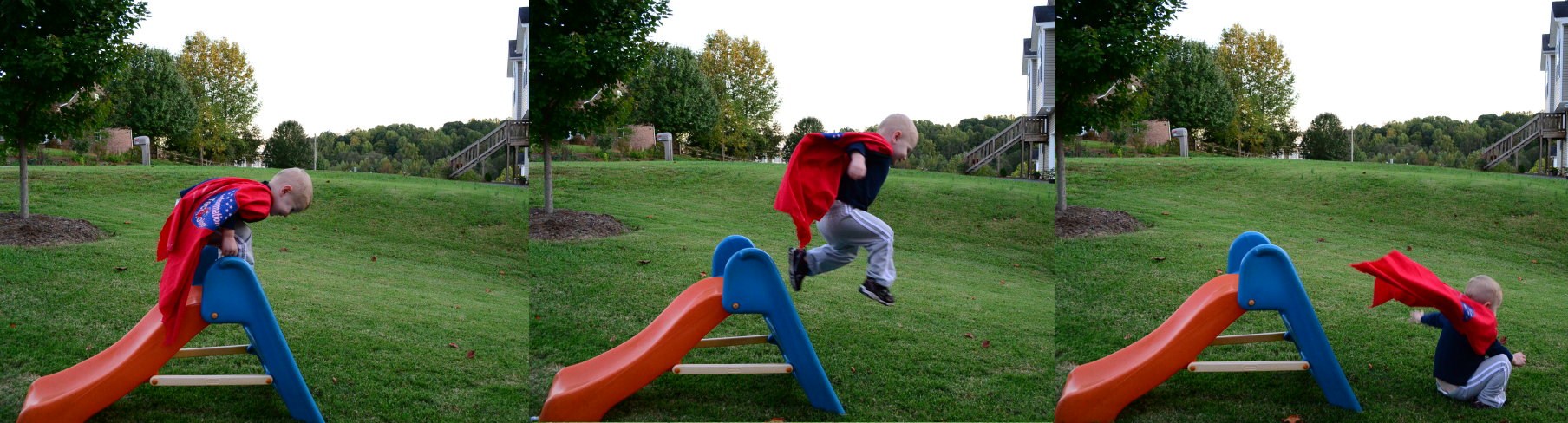
Children learn from play. They learn how to move their bodies, make things like forts or “play houses” out of leaves. They learn to negotiate with siblings or playmates – “May I have the next turn on the swing?”. Children also learn to problem solve when things don’t go as planned while they play. Play allows creativity as children create “meals” from hickory nuts, leaves, and pieces of gravel. Boys will make play weapons out of sticks, dried plant stalks, or pieces of bark and carry on battles with imaginary foes. I am constantly amazed to see the way our grandchildren “make-believe” with found objects collected all around our yard. This type of experiential learning does not take place riding in the car from one practice to another.

I fell victim to this malady as a mother of young children. I had visions of a string quartet practicing daily in our den and then playing for worship on Sundays. What if one of our children was a musical prodigy but never had the chance to play an instrument? Additionally, research shows that children who are musical do better in math! So I proceeded to offer (force?) each child a chance to play a stringed instrument. One by one, each quit to pursue other interests of their own choosing. Hannah was my one hold out and played the violin from six years old until she was thirteen. Then she begged to quit. My husband finally said to me, “Gayle, is Hannah taking lessons for you or herself?”  In all honesty I had to admit it was for me.

If a child has a strong interest and desire to become involved in music, sports, drama, etc. and shows a willingness to practice then this may be an important involvement for that child. But, it is essential as a parent to limit a child’s commitment of time and energy so that important things like family, fellowship, school, and PLAY don’t become neglected because of a schedule that is too busy. One of our children was a joiner – we teased that she would have joined the Communist Party if there had been one in Sylva. We had to say “no” several times until she learned to say “no” for herself.

Psalm 46:10

 He says, “Be still, and know that I am God;
I will be exalted among the nations,
I will be exalted in the earth.”

This verse illustrates a part of our nature as human beings. We must be quiet in order to hear God, to distinguish His voice over all that goes on around us. We are created for God’s pleasure, to worship and honor Him. Our children need to learn to be comfortable with quiet time, to learn to be still. As they mature they will be able to recognize God’s voice even when He chooses to speak in a still small voice.

Expectations

Gayle with family in 1972

” I could never live up to her expectations.” How often have you heard this tragic statement in regard to someone talking about a parent? Sometimes a father, sometimes a mother, but equally heart-rending. Living with the feeling that you did not measure up is sometimes debilitating, but always hurtful. The offending parent may have never verbalized their attitude towards the child, but in this case actions do speak louder than words. Looks of disdain, ignoring a child’s presence or needs,  just being too busy to listen all communicate lack of regard for a child.

Making fun of a child who makes a mistake, whether physical or verbal, is so hurtful. This can not only make a child feel inadequate, but can make a child feel like not trying something  new for fear of failure. Parents must guard their speech to prevent hurtful words from wounding their child. Words spoken in frustration and impatience are especially scaring. One of the most harmful responses to a child is comparing that child to someone else in a negative way. “Why can’t you be like so and so…..?” “Why can’t you be more like your brother?”

I have an older brother who was a high achiever in everything he did. He made excellent grades, was a good athlete, played the trombone, and NEVER got in trouble. My parents made it a point to not compare myself or my younger brother to our older sibling. They expressed pleasure in my feeble athletic pursuits, praised me for the grades I earned, and more importantly, supported my unique pursuits in artistic expression and theatre, things my brothers did not do. There was not a sense of competition in our home – but a realistic expectation that each of us would do our personal best. We are all different, and encouraging those differences is important. We tried to do the same with our four children, celebrating their differences and unique qualities. I can’t say that there was never competition between them, but it was self-inflicted, not from their father or me. The following Scripture is very meaningful to me –

Psalm 62:5   “My soul, wait thou only upon God; for my expectation is from Him.

It is natural for parents to have expectations for their children. We must make certain that our children know we love and accept them unconditionally. They must know that our love is not based on whether or not they meet our expectations.  The second part of that verse holds the key – “my expectation is from Him”. We must allow God to form our children according to HIS good pleasure, not ours. I particularly like the verse  Ephesians 3:20 in the Amplified version.

“Now to Him Who, by (in consequence of) the [action of His] power that is at work within us, is able to [carry out His purpose and] do superabundantly, far over and above all that we [dare] ask or think [infinitely beyond our highest prayers, desires, thoughts, hopes, or dreams]–“

Now I can think of some pretty wonderful things to have happen for my children and grandchildren. Yet this verse states the fact that what God has planned for them is better then anything I can even think or dream!

So – the challenge for us as parents and grandparents is to let our expectations come from God.