Heirloom Plants and People

img_6987

Heirloom plants are all the rage now. At our local farmers market you can find plants that our grandparents ate frequently, but that I had never seen for sale locally. One plant that is becoming increasingly visible is beets. If you believe the “info-mercials”, beets are the answer to all the physical and mental problems one might face.

My grandparents ate beets. LOTS of beets. Grandma Barker was a wonderful cook, but I never developed a taste for her beets. Grandma and Grandpa Barker moved into our home when I was 11 years old and they brought their beets with them. Grandpa Barker loved potatoes at every meal and Grandma cooked the most delicious potato dishes. Fried potatoes with onions, scalloped potatoes, potato salad, boiled potatoes, and mashed “to perfection” potatoes.

Yet the image of the beet juice creeping slowly across their plates and turning the delicious mashed potatoes pinkish purple still sends culinary chills up my spine.

I have been thinking recently about the heirloom plants that people are now planting in their gardens. I have some heirloom flowering plants that were on our property when we bought it and are as old as our home built in 1880.

What is this fascination we have with the past?

Obviously everyone does not have it. One of our daughters lives in a home where all the furniture is new. It is lovely.

We buy old, vintage furniture and treasure the family heirlooms we are fortunate enough to have. We nurture and protect the old plants and flowers that grace our yard with their perennial beauty.

Truth be told, new appliances are a blessing. I am thankful for a washer and dryer, even though I enjoy using a clothes line, weather permitting. I am glad I don’t have to use a wringer washer and heat the water on the woodstove to wash our clothes. We actually have an heirloom hot water heater in our cellar. It is cast iron and was fed with coal. Our electric hot water heater sits next to it connecting to the hot water pipes that plumb our house. I’m glad I don’t have to stoke a coal fire every time I need a shower!

There is a balance between honoring the heirlooms of our past and utilizing the benefits and innovations of our current culture.

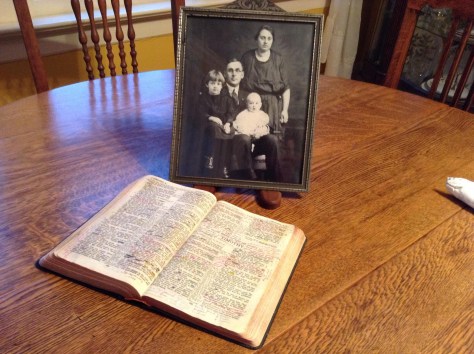
My mother recently gave me my Grandma Barker’s Bible. It is a King James Version which my Grandmother gave to her father, George Auman, in 1946. He was a pastor in the United Brethren in Christ denomination. My Great-grandmother gave it back to Grandma Barker in 1956 after Great-grandpa Auman passed away. Grandma had it rebound in 1964 and she writes in the fly leaf – “The * in the margins are Dad’s markings.”

Grandma has written many notes throughout this Bible in her beautiful, distinct hand. It is well worn, well read, and an heirloom I treasure. It demonstrates her sincere faith on every marked page.

img_6989

In II Timothy 1:5, Paul says –

I am reminded of your sincere faith, which first lived in your grandmother Lois and in your mother Eunice and, I am persuaded, now lives in you also.

As a grandmother now myself, I want to live like Lois did, like Grace Auman Barker, my grandmother did.

I want my grandchildren to remember my sincere faith.

And when they see the carefully tended heirloom flowers, or the notes in my journals and Bible, I hope it points them to the God who loves them and blesses them as Grandma’s Bible blesses me.


In My Garden With God # 13
“Before you know it, …”

img_6836

“Before you know it, that kudzu will creep right on in your bed!”

One of the pleasures of walking for exercise is the encounters you have with people who are also walking.

Now some of you are thinking…”I like to exercise alone.” Good for you.  But I know that once I moved away from my walking buddy – Alice Marie – my exercise level went way down. I do better when I talk and walk.

So – on Monday as I was walking by myself,  I saw another frequent walker. We greeted one another and then started talking about all the rain we have had recently. Weather is a frequent topic because it affects all of us and our walking. Then we talked about our gardens, what was doing well – cucumbers, which like the rain, and what was not doing so well – tomatoes – which prefer hot, dry weather.

Then our conversation moved on to kudzu. Kudzu must REALLY like the rain because it is growing up a storm! My friend mentioned that she and her husband used to own some land where they had cows and never had any trouble with kudzu. When they sold the land, the new owners didn’t want cows and before long called and asked what they could do about all the kudzu. It was taking over their land.

“Before you know it, it will creep right on in your bed!” my fellow walker said.

We laughed together, knowing just how close to the truth that statement is.

A little Kudzu history – it originally came from Japan –

“In the decades that followed kudzu’s formal introduction at the 1876 World’s Fair Centennial Exhibition in Philadelphia, farmers found little use for a vine that could take years to establish, was nearly impossible to harvest and couldn’t tolerate sustained grazing by horses or cattle. But in 1935, as dust storms damaged the prairies, Congress declared war on soil erosion and enlisted kudzu as a primary weapon. More than 70 million kudzu seedlings were grown in nurseries by the newly created Soil Conservation Service.”  Read more: https://www.smithsonianmag.com/science-nature/true-story-kudzu-vine-ate-south-180956325/#tvkuq1M1sB0CAeTS.99

So – kudzu found a home in the United States to combat soil erosion.

A good motivation – an unexpected result.

I thought about this and a parallel principle to Spiritual growth.

As Christians we are often looking for “quick fixes” to our problems. Some of the these ideas are good. They even work for a time. But there are unexpected results that we didn’t anticipate.

A few examples:

  • marriages in the church are struggling – have a marriage conference
  • children don’t want to sit quietly in church services –  offer children’s church

The marriage conference may offer great information, but what about a month later when the old conflicts rear their ugly heads (and they will) what does that couple do?Having a mature, Godly couple mentor those struggling in their marriages provides ongoing support and PRAYER which is powerful in effecting real, sustained change.

Children’s Church can be a blessing for parents who want to focus on worship. Yet these children specific offerings often become entertainment, not real worship. They do not prepare children to block out distractions so they learn to focus on worshiping the King of Kings, Creator of the Universe, their Lord and Savior. Toddlers do need separate space. But once children begin school, they are able to learn to participate in the most important activity of human experience – Worship of God. By participating in worship, children will learn to worship.

Psalm 100

Shout for joy to the Lord, all the earth.
Worship the Lord with gladness;
    come before him with joyful songs.
Know that the Lord is God.
    It is he who made us, and we are his;
    we are his people, the sheep of his pasture.

Enter his gates with thanksgiving
    and his courts with praise;
    give thanks to him and praise his name.
For the Lord is good and his love endures forever;
    his faithfulness continues through all generations.

We must make sure that we are not practicing “quick fixes” in our spiritual lives that cause us and our children to experience unexpected consequences.

Before you know it….!


In My Garden with God – #12

“They Need to See Each Other”

When my father passed away several dear friends gave me gift cards to purchase a plant in his honor. This was especially fitting since my father was a botanist and naturalist, as well as a biology teacher.

I knew immediately what I wanted to plant in his honor… an American chestnut tree, blight resistant.

When my father became a seasonal ranger in the Great Smoky Mountains National Park in 1959, one still saw many towering gray tree trunks of dead American chestnuts, the last vestiges of a once mighty species of tree in our mountain forests.

Years later when my parents were living with us, Dad told me that he had read about a blight resistant American chestnut that had been developed and was showing promise of thriving in our mountain habitat. He mentioned that we should get one. I called around to a few local nurseries and no one had any of this variety yet.

So, after my father passed away at 91 years old, I again called the nursery and sure enough, they had American chestnut trees. Phil and I went to pick one up and the man helping us said,

“Now you need two so they can cross pollinate and you then you will get chestnuts.”

Of course – Biology 101.

Thinking about the many trees on our property already,  I asked, “How close do I need to plant them?”

“They need to see each other.” he said.

I smile every time I remember this conversation. As I was weeding around those two trees recently, which by the way are growing very well, I was reminded of a spiritual principle that those trees illustrate perfectly.

Trees will only bear fruit, (or nuts) if they are close enough to each other to cross pollinate. As Christians, we will only bear fruit if we are in close relationship to other Christians. We need the cross pollination of our brothers and sisters in faith to keep us growing spiritually in healthy ways.

Some of the effects of cross pollination are:

  • recognizing Truth vs. deception
  • being held accountable to Godly behavior
  • growing the fruit of the Spirit – love, joy, peace, patience, self control, etc.
  • learning from what the Lord is impressing on fellow believers
  • being challenged to love and good works
  • reproducing more Christians

It is hard to demonstrate REAL love, patience, or self control if we are all alone. Expressing real love requires an object of that love. My patience is most often challenged by others and I learn to be patient by practicing it on others. It is hardest to demonstrate self control over my tongue when there is actually someone around to hear me. It is through close contact with others that I cultivate the fruit of the Spirit.

I Corinthians 12:12-13, 18-21 says the following –

12 The human body has many parts, but the many parts make up one whole body. So it is with the body of Christ. 13 Some of us are Jews, some are Gentiles, some are slaves, and some are free. But we have all been baptized into one body by one Spirit, and we all share the same Spirit.

18 But our bodies have many parts, and God has put each part just where he wants it. 19 How strange a body would be if it had only one part! 20 Yes, there are many parts, but only one body. 21 The eye can never say to the hand, “I don’t need you.” The head can’t say to the feet, “I don’t need you.”

We need each other – to grow, to be healthy, to reproduce.

We must remain close to others Christians, close enough to see each other.


In My Garden with God #10