Physical Training

I remember looking at my father’s Biology textbook and being spellbound by the pictures of human anatomy.  The most amazing part was the way the transparencies would layer each other showing first the skeletal structure, then the muscles and ligaments, the circulatory system, the organs, and finally the skin covering the human form.  Each page was fascinating and complex, and when I finally was in 10th grade and learned about the systems of our bodies and the way each worked in support of each of the others, I developed a deep respect for the manner in which the human body was created. To think that we are the result of innumerable mutations is beyond rational thought  in my humble opinion!

Psalm 139:14 (NIV)
14 I praise you because I am fearfully and wonderfully made;
   your works are wonderful, I know that full well.

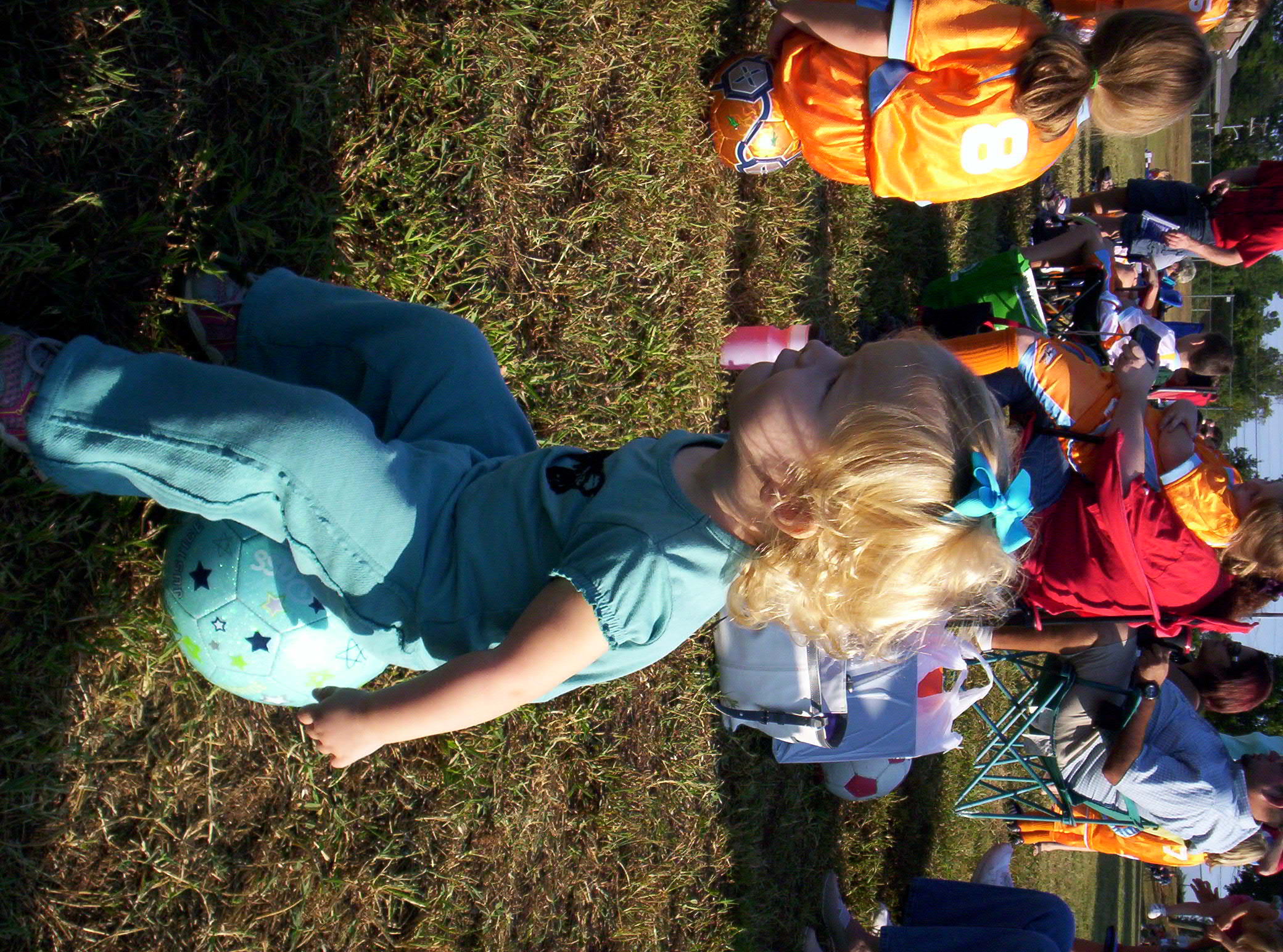
Yes, our bodies are wonderfully made and I believe it is important to instill in our children an early respect and appreciation of our bodies as God created them to be. Physical activity brings such joy to children. We have three grandsons who are nearing their first birthday and as they pull up on everything in reach, it tickles me to watch them “dance” whenever they hear music. They bounce and sway to the music, and it comes naturally without any intentional instruction.

It is also fun to watch children when they are set free in a wide open space – they RUN! You open the car doors at a park and as soon as they get free of the confines of their seat belts they burst forth with physical activity. Healthy bodies were designed to move, and when we are able to use our bodies as God intended, it brings joy. Our brains release serotonin when we engage in physical activity and it works in children as well. Children need to play physically. They will eat better, sleep better, and get along with others better when they move muscles and expend energy. Think about the times weather prevents outside play (cabin fever) and the irritability that results in the parents as well as the children. Planning physical activity is just as important as planning meals and naps.

Some ways to work physical activity into busy schedules are:

  • take walks while supper is in the oven. The walk can be short, but it will exercise muscles and encourage appetites.
  • dance around to a favorite praise CD, even create your own exercise routine, jumping, hopping, arm circles, toe touches, etc.
  • make a obstacle course/fitness course in your yard. This can be very simple: a log to jump over, a landscape timber to balance along, a tree/bush, rock, to run around and back.
  • ride bikes/ tricycles  together.  This may not be possible depending on location, but bike riding and scooter riding certainly gets the heart rate up.
  • walk to places whenever possible. Again, this depends on your location, but it provides exercise while getting you to your destination.
  • include your child in your personal exercise routine at times. This is not always possible, but even if you must adapt your pace or length of workout to include your child, it will reap great rewards.
  • find a nearby park and meet friends/family there to play
  • some children are born with physical limitations. It is a special challenge for parents to work with these children within the limits of their physical abilities.

I Corinthians 9: 24-25

 24 Do you not know that in a race all the runners run, but only one gets the prize? Run in such a way as to get the prize.                              25 Everyone who competes in the games goes into strict training. They do it to get a crown that will not last, but we do it to get a crown that will last forever.

These verses refer to the physical discipline that athletes need to succeed, just as we must discipline ourselves to follow Christ. All of us must find the physical activities that best meet our children’s unique situation. Making  physical activity an early and important part of our child’s life will bless them for them for the rest of their lives and celebrate the glory of God’s creation.

Next week the topic is Emotional Health of Young Children.

First, Best Teacher

It’s back to school time for those 5 years old and older. Yet our role as our child’s teacher begins long before 5 years old and that role doesn’t come with summer breaks or holidays. It is seven days a week, 360 days a year. Yet, there are great and lasting benefits!

This may not be a job we planned on signing up for when we became parents, but each of us finds ourselves in this role none the less…teacher! Parents are the first teachers a child ever has. From the child’s very first cry and the mother’s and father’s first embrace, teaching is taking place. We show our child how to get our attention by responding to those cries and meeting the child’s needs. This is not a surprise, nor should it be. We expect to teach our children how to talk, walk, put their clothes on, eat with a spoon, etc. What we may not have realized is just how important that role , teacher, will continue to be as our child grows older. Even when our children attend school whether it is a public, private, Christian, or secular, our role as a parent remains of utmost importance. We must lay the groundwork now for being effective as teachers of our children’s moral and spiritual development, as well as their intellectual and physical growth.

In the early years the brain nearly triples in size and weight. Up until age two there is a huge buildup of neural connections. This is followed by a massive pruning. This brain reorganization is often characterised by the Terrible Twos. The erratic behavior of the child reflects the changes taking place in the brain. Pat Wolfe; Brain Matters

Current research in brain development validates what many of us already know – the toddler years are a challenging time. Yet it is also a time when the brain is solidifying connections that will greatly impact our child’s growth and development intellectually, physically,  emotionally, and spiritually.

I would like to address one of these four areas for each of the next four weeks. First – intellectual growth.

The brain responds to repetition. Current brain reasearch shows this – but any mother of a toddler knows that they love to hear the same story over and over again. They learn colors, numbers, names of things, and people by hearing them repeated over and over.

Learning is the act of making and strengthening connections between thousands of neurons (neural networks)

Memory is the ability to reconstruct or reactivate the previously made connections.      Pat Wolfe – Brain Matters

So, repetition is an essential part of teaching our child about the world around them. As a child begins to remember information, they are using words they have heard repeated over and over and those words contain meaning for them. The more those neurological connections are used, the more permanent they become.

Think about this – do you remember the nursery rhyme “Jack and Jill”? When was the last tine you practiced repeating it? It may have been years – yet those early neurological connections were made permanent by the repetition of that verse when you were young. This holds true for our children as well. It would bless our children if we are intentional and careful about what we allow them to see and hear over and over. Neurons are continuously “firing”.

Reading to children is the most important intellectual preparation parents can provide for children. Stories build vocabulary, make connections to the world around them, and provide sequential information, while providing pleasure, humor, and closeness as parents and children read together.

Psalm 139:14 (NIV)
14 I praise you because I am fearfully and wonderfully made;
   your works are wonderful, I know that full well.

The God who created our brains will also lead and guide us as parents to be the teachers He desires us to be.           What a privilege and blessing!

Next week we will look at teaching healthy physical development.


Think on These Things

My friend Alice Marie and I recently attended church with her mother and the pastor said that many of us suffer from a syndrome called “ANTS”  – Automatic Negative Thought Syndrome. I remember being affected by this malady  – especially as my children were going through one or another  “phase”. I KNEW meal time would be a whine fest, nap time a challenge, and bath time a wrestling match. By anticipating negative behavior, was I setting myself up for difficulty? Probably so. Children do go through phases and their brain development as toddlers does precipitate some erratic behavior, but I know that when I expect the worst – that is most likely what I will get.

You’ve heard the saying (pardon the grammar, Phil) “When mamma ain’t happy, ain’t nobody happy!” We mothers do set the tone in our homes. If we are negative, our children will be as well. If we respond to whining with a firm, “Tell me what is wrong, I can’t understand when you whine”, instead of whining right back with, “You always whine and it’s driving me crazy!’ we will redirect the negative behavior. It is not easy – because whining DOES drive us crazy, yet as an adult, I must choose to model a positive attitude.

Philippians 4: 8 says,

Finally, brothers and sisters, whatever is true, whatever is noble, whatever is right, whatever is pure, whatever is lovely, whatever is admirable—if anything is excellent or praiseworthy—think about such things. ”

Paul is encouraging us to choose positive thoughts with which to fill our minds. Thoughts determine our speech and then lead to the actions we take. If my thoughts toward my children are lovely and admirable, it follows that my speech will be as well.

When our children were young my friend Carol made me a cross stitch of this verse which I hung in my kitchen. It seems like I needed it in the kitchen the most. You might have a room or a situation that is a challenge for you, where you feel “ANTS” taking over. If it would help, make a list of true, noble, right, pure, lovely, and admirable thoughts. Hang it up. The list may change from time to time.  Yet the principle remains the same. Think on these things.