Along for the Ride

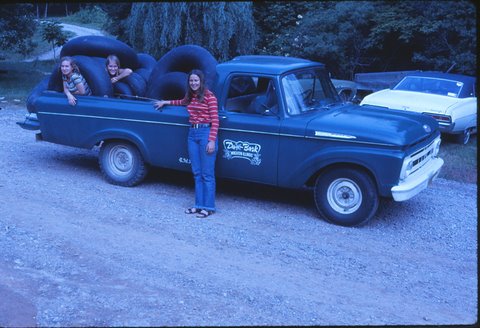
Old Holly Cove Truck

When I was 10 years old my parents operated a campground in the summers for families camping in tents and trailers. It was located in the Great Smoky Mountains of western North Carolina and my brothers and I spent delightful summers working and playing alongside our family and friends. Dad had an old Ford truck and every time we children heard the engine crank, we ran to ask if we could go along for the ride. We would jump in the back of the truck, make sure our “bottoms were on the floor” and off we would go. Sometimes Dad would say, “Do you want to go with me?” since he knew we enjoyed feeling the air rush through our hair as it cooled us off on a hot summer day.

We never asked “Where are you going?” It didn’t matter. We were along for the ride. We didn’t care about the route or destination because the ride itself was exciting. Thinking about it now brings back a flood of pleasant memories. If my memory serves me rightly, the majority of the trips were to Sylva Coal and Lumber or Vance’s Hardware Store. Dad  would buy supplies for campground repairs, and we would return home, riding in the back of the truck with whatever he had purchased.

God wants us to respond to Him in much the same way my brothers and I responded to our father.  He has called us to follow Him – He often doesn’t tell us where we are going or why. We may not know where we are going, but we do know who we are going with. When God called Abraham ( Abram at that time) to a foreign land, He didn’t tell him much about the destination.  Abram knew God and trusted Him. The Bible is full of people who walked by faith. There are also numerous accounts of those who didn’t and the results aren’t pleasant.

I realize as I get older that it is the process of following God – or journey itself – that is important, not just the end result or the destination.

Matthew 16:24-25 (NIV)

 24 Then Jesus said to his disciples, “Whoever wants to be my disciple must deny themselves and take up their cross and follow me. 25 For whoever wants to save their life[a] will lose it, but whoever loses their life for me will find it. ”

Being an effective mother is losing our right to our own way, as we stated in an earlier post. Yet I know that too often I have focused on the “goal” ahead of me instead of  following God – whether the goal was getting the babies out of diapers, helping them learn to talk, walk, feed themselves, etc. Instead, I should see the day-to-day challenge of being a mother as significant.  If I could see each day as a “ride in the back of the truck” instead of a destination that must be reached I believe it would facilitate my desire to be a follower of God. As I relinquish my control over the destination – “losing my life” – God will take me where He wants me and I will “find my life” in Him.

Genetic Implications

Yesterday was Father’s Day and I am still blessed to have my father with us, in fact my parents live in our home. In thinking about the qualities that I most appreciate about my father, it is his faithful example of being a godly man that most stands out. He taught high school Biology for 40 years, 33 at Wheaton Central High School in Wheaton, Illinois, and after taking early retirement, he taught at a mission school in Taichung, Taiwan for 7 more years. He never lost his passion for teaching or his wonder at examining the uniqueness of God’s creation. My father was respected by his peers in education as well as his students. I know this because I attended the high school where my father taught. He has a natural ability to command respect in his quiet, but firm way.

When I was a junior in high school I tried out for the school musical, “Oklahoma.”  I was thrilled to get the part of Aunt Eller!  She was a feisty old lady, a part I could really get into! – until I read the script.  She cussed!  Those words jumped off the page at me and I knew deep down I couldn’t say them. I knew actresses are just ‘playing a part’ and that it wouldn’t be me saying those words but Aunt Eller; yet my overwhelming thought was ‘My father would be ashamed of me.’ I know he would see his daughter on stage, not some fictional character. I knew I had no choice. The next day I took the script to the director knowing that what I had to do might lose me the part. I showed the director, Mr. Schomas the page of dialogue and said “I can’t say those words.”  If I’d said anything more I would have cried. He looked at me and replied “I know your father. Just say something else that you feel is in character.”

My father’s conduct in and out of the classroom was consistent.  His fellow teachers saw that he lived what he preached and I was the beneficiary of that reputation. The thought of bringing shame to my father was of greater consequence to me then keeping a part in the play. Yet because he was respected, I was able to do both. The implications of the integrity of my father’s life continue to bless me to this day.

We know there are no spiritual grandchildren, yet I have inherited a rich treasure of spiritual ‘genes’ from my father. How much more our Heavenly Father wants us to be blessed by the spiritual treasures of our life as His children. He has SO MUCH to give us, yet we must be willing to receive from Him. Look at what Scripture says  –

1 John 3: 1,2

 1 See what great love the Father has lavished on us, that we should be called children of God! And that is what we are! The reason the world does not know us is that it did not know him. 2 Dear friends, now we are children of God, and what we will be has not yet been made known. But we know that when Christ appears,[a] we shall be like him, for we shall see him as he is.

Tone of Voice

“Watch your tone of voice, young lady!” This was an admonition I frequently heard growing up – and my mother said it in a FIRM tone of voice. Many of us learned in Psychology 101 that a key to effective communication is understanding how communication works. Studies have shown that only 15% of what we communicate verbally is from the actual words we say. That means 85% of communication comes from facial expressions, emphasis, body language, and tone of voice.  (It makes me wonder about those who communicate primarily with texting.)

What does this mean to us as mothers? I learned an important lesson from our son when he was about 8 years old. I was busy asking our four children to help get the house picked up for a home group meeting. I was giving directions and Benjamin asked me “Why do you always talk to me in a mean voice and Abi in a nice voice?”                                                  It stopped me up short – I realized he was absolutely right! In asking my children to clean up I communicated impatience and aggravation to my oldest child and patience and grace to the youngest.  “CLEAN UP RIGHT NOW!” spoken harshly and with a stern look on my face communicates something very different from “Clean up right now” said more softly and with a smile. Same words – different meaning. I had developed a pattern of speaking harshly to my oldest because I expected more from him. That in itself was not a bad thing, he WAS older and I could reasonably expect more from him at 8 years old then from his little sister who was 4. Yet I was communicating impatience and aggravation to one child and patience and grace to another for the same behavior! How willing  to obey can we expect our children to be when we speak to them in that way? I asked our son for forgiveness and told him I would try to talk to each of our children the same. I started talking mean to his little sister as well! No, just kidding. It was a struggle, but I began working on using a tone of voice that communicated love and grace even when I had to be firm.

Ephesians 4:29 “Do not let any unwholesome talk come out of your mouth, but only what is helpful for building others up according to their needs, that it may benefit those who listen.” What a great verse for mothers! I like how the Amplified translation words the last part – “but only such speech as is good and beneficial to the spiritual progress of others….that it may be a blessing and give grace to those who hear it.”

 Words of kindness are a source of healing and that is so important when our children are hurt by the mean words of others. Our children’s speech often reflects our speech. How many of us have been embarrassed to hear our child speak a certain word only to realize they learned it from us! This is true of the tone of voice as well. The way we speak to our husbands will be the way our children learn to speak to their father. They will mimic our tone of voice. May we learn to reflect the love and respect that God holds for each of us when we speak to our husbands and children.